Executive summary
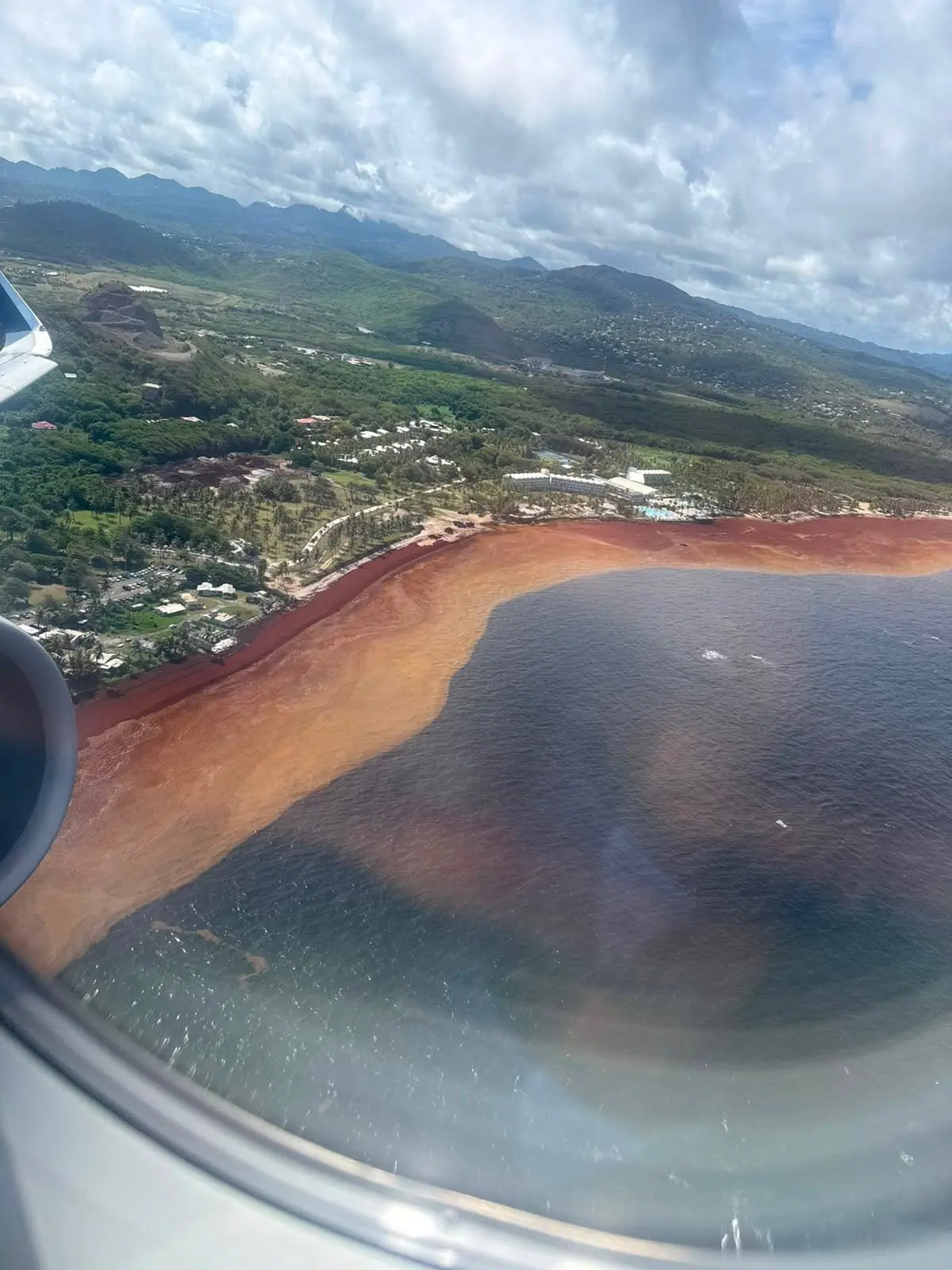
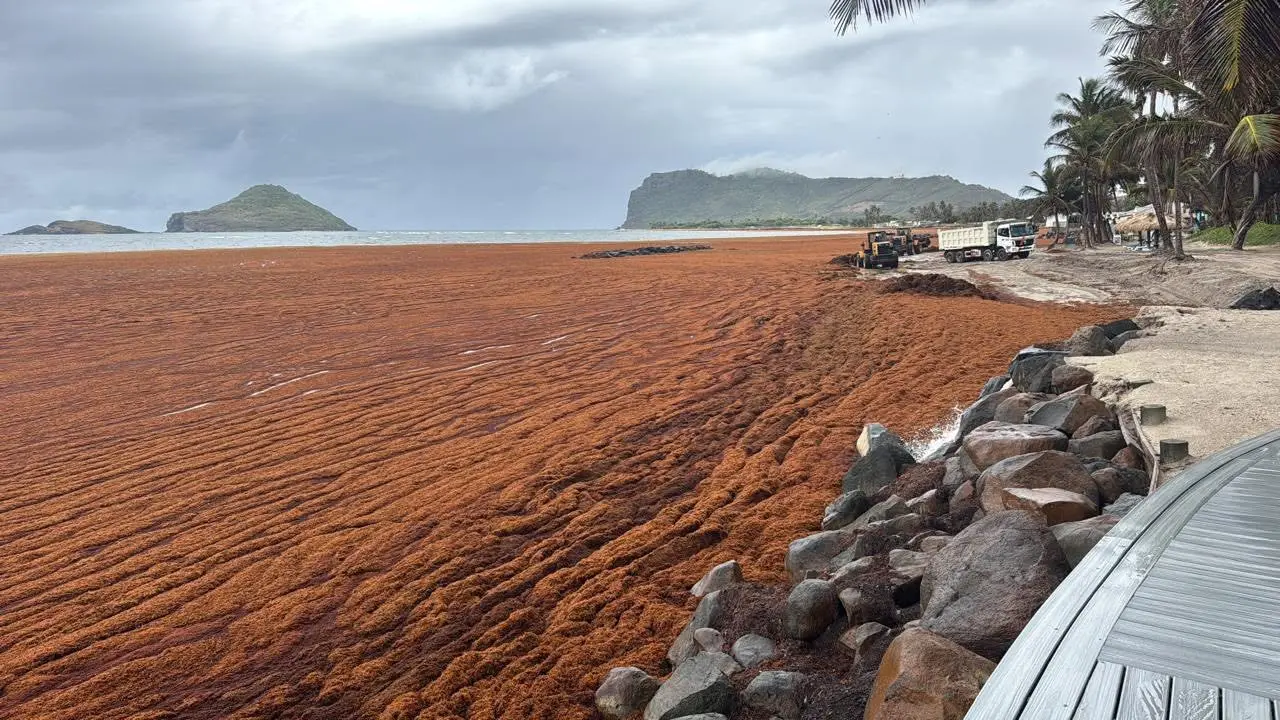
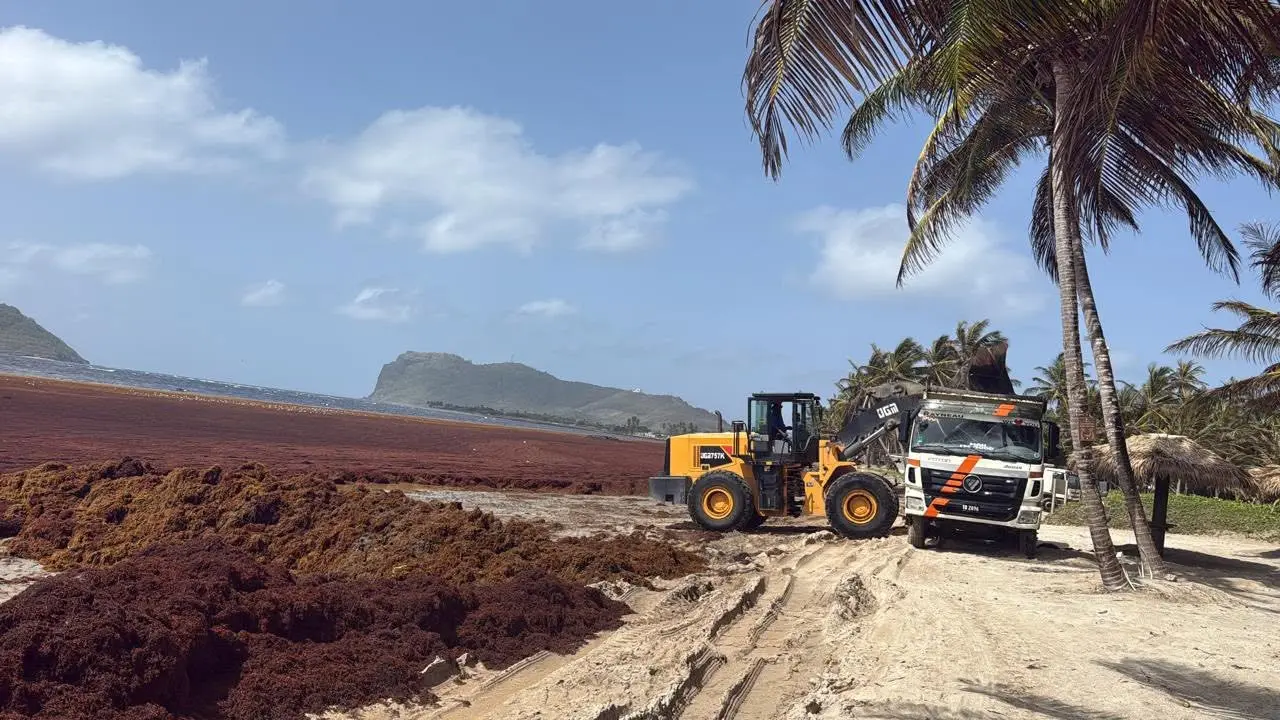
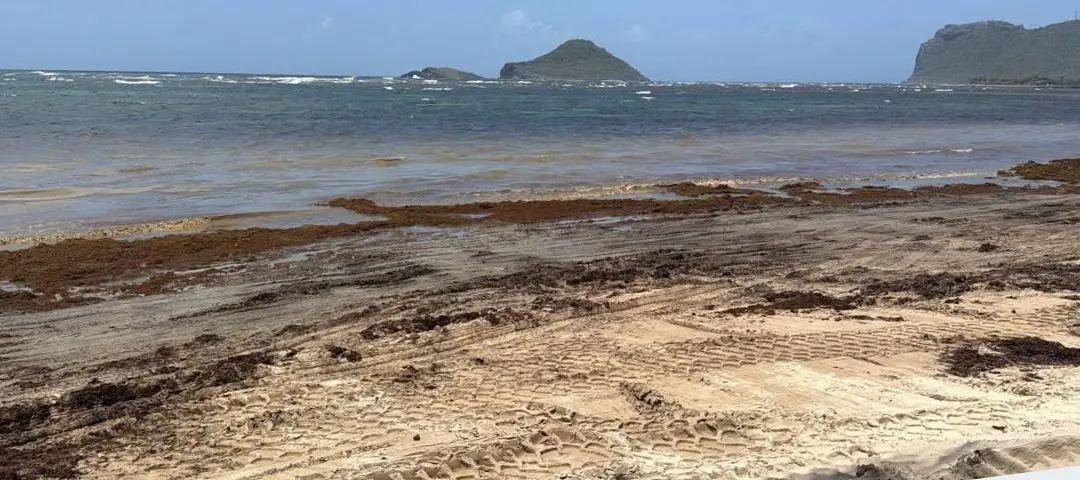
A 2026 photographic sequence now records a heavy Saint Lucia shoreline accumulation, loaders and trucks moving material, and the beach after a cleanup pass. It confirms that response is an operating chain involving access, crews, machinery, loading and transport. The images do not establish volume, response time, cost, worker exposure, sand loss, destination or ecological outcome; those remain the measurements a public operating account should supply.
The 2026 season changes the operating question. USF's satellite system estimated about 33.6 million metric tonnes across major Atlantic–Caribbean regions in June; a record June signal, not a Saint Lucia beach forecast. Saint Lucia also received two boats, three tractors, specialised attachments and protective equipment in February under a regional UNDP programme. The priority is now to make that capability measurable: which sites, what trigger, what response time, what destination, what cost and what health result.
Cleanup and commercial use require separate accounts. A Mexico study reported cleanup at US$19–85 per cubic metre. Belize's new US$960,388 conversion project is still a test of economic viability. Saint Lucia can use those figures to bound a learning season, but local procurement, landings, chemistry and markets must determine any permanent commitment.
Three different questions are often collapsed into one word: sargassum. First, decomposing beach accumulations release hydrogen sulfide and ammonia that can affect nearby residents, workers and sensitive people. Second, pelagic sargassum can contain elevated inorganic arsenic and other contaminants that constrain reuse. Third, whether those contaminants create a material risk in particular Saint Lucian seafood species is an empirical question that has not been answered by a public local sentinel series.
The public-health case for action does not depend on proving every proposed pathway. Gas exposure near decomposing mats is established, and symptoms can include respiratory irritation, headache, nausea, vertigo and neurocognitive effects at sufficient exposure. Anecdotal neurological complaints in Saint Lucia cannot establish sargassum as the cause; they do justify an exposure-aware surveillance design that records place, timing, wind, measured gas levels and clinical findings.
The seafood evidence calls for precision rather than panic. A Martinique study found concerning arsenic exposure potential in two bivalve species collected in a sargassum-affected coastal zone. That result does not prove dangerous inorganic arsenic in Saint Lucian finfish muscle, and it does not support a blanket warning against local fish. It supports a transparent sampling programme that distinguishes species, habitat, edible tissue, total arsenic and inorganic arsenic, with exposed and comparison sites.
Saint Lucia already has pieces of the solution: specialised collection equipment, participation in regional sargassum cooperation, a new digital event-based health-surveillance system, and the FISH-ADAPT platform for fisheries resilience and data. SLPA proposes joining those pieces into one seasonal command system that forecasts, senses, protects, tests, publishes and only then authorises value chains.
Developed from a Saint Lucia research line that separated the proven inhalation hazard from an unresolved seafood pathway and the conditional blue-economy opportunity. Current regional science, Saint Lucia programmes and public-health guidance were reviewed in July 2026.
Health hazards and programme records are sourced. The 2026 biomass figure is a regional satellite estimate, not a Saint Lucia landing count. Cleanup prices are external benchmarks and SLPA calculations, not bids, approved budgets or forecasts.
Key findings
Price each response by volume and exposure avoided.
A public incident record should join measured wet volume to response time, cost, equipment hours, destination, worker exposure and ecological loss. That makes a cheap but late or damaging cleanup visibly different from a fast, safe one.
Evidence-led finding · Source SG2Equipment becomes capability when its operating chain works.
Saint Lucia now has confirmed tractors, boats and PPE and is considering a multi-sectoral task force. Publish the asset register, readiness, crew, fuel, maintenance, priority sites and response thresholds so the handover becomes a dependable seasonal service.
Evidence-led finding · Source SG4A product pilot must prove safety, yield and a buyer.
Regional projects show serious experimentation, but approved budgets and laboratory conversion do not prove commercial viability. Every pathway should pass batch contaminant, residual, product-standard, customer, unsubsidised unit-cost and shoreline-relief tests before scale.
Evidence-led finding · Source SG5Test a boom at one sheltered site, not around the island.
Comparable systems show that barriers require engineering, anchors, daily clearing, inspection and a storm-stow plan. A 150–250 metre trial should proceed only at a hydrodynamically suitable site and continue after month nine only if avoided shoreline load and ecological results justify its full serviced cost.
Evidence-led finding · Source SG7Stranded sargassum becomes more dangerous as it decomposes.
Floating sargassum is valuable marine habitat. Thick stranded mats can decompose rapidly under Caribbean conditions, releasing gases, consuming oxygen, degrading water quality and creating a different occupational and community-health problem. Response time therefore matters.
Evidence-led findingGas sensors are needed because smell is unreliable.
Hydrogen sulfide can cause olfactory fatigue, while wind and topography change exposure over short distances. Priority communities, schools, clinics and work sites need calibrated sensors, meteorological context, alert thresholds and clear actions, not reassurance based only on smell.
Evidence-led findingLocal seafood risk can be measured by species and tissue.
Caribbean bivalve evidence shows that arsenic can matter in a sargassum-affected food web, while finfish risk remains unresolved and depends on species, habitat, tissue and arsenic form. A sentinel should test edible tissues and speciate arsenic rather than treat total arsenic alone as the final health answer.
Evidence-led findingEach commercial use needs its own safety test.
A biomass acceptable for energy conversion is not automatically acceptable for animal feed, compost or food-crop soil. Every pathway needs contaminant, leachate, salt, pathogen, emissions and residual-waste standards, with batch testing and a destination for rejected material.
Evidence-led findingJoin current programmes into one seasonal response.
Satellite outlooks, SARSEA cooperation, national collection equipment, health event surveillance and FISH-ADAPT can share a seasonal map, incident levels, sampling plan, community notices and after-action review instead of operating as separate projects.
Evidence-led findingComparable operating and market testsMexico prices cleanup; Belize is testing commercial use.Neither case is a template. Together they show the two accounts Saint Lucia needs: the public cost of control and the separate evidence required for a viable product.2 cases
Observed cleanup costs ranged from US$19–85 per cubic metre, while annual volumes and costs varied widely by site and management method.
- What produced it
- Municipal and hotel records joined volume, beach length and spending, making unit costs visible instead of treating tonnes removed as the only result.
- Use in Saint Lucia
- Measure wet cubic metres or tonnes at loading, attach labour, fuel, transport, destination and machinery time, and publish cost by site and method after each response episode.
- Boundary
- Mexico has different beaches, tourism density, wage structures, volumes and disposal routes. The range is a planning boundary, not a quote or forecast for Saint Lucia.
A US$960,388 project approved in 2026 is explicitly designed to demonstrate economic viability for compost and hydrolysate.
- What produced it
- Grant and counterpart finance support a community-centred pilot that must connect conversion, products, jobs, methane reduction and market demand.
- Use in Saint Lucia
- Require a commercial pilot to publish feedstock condition, contaminants, conversion yield, energy and water use, product safety, buyer tests, residuals and unsubsidised unit economics.
- Boundary
- The project is in implementation. Its budget and stated objective are not evidence of profitable sales, safe Saint Lucian feedstock or large-scale shoreline relief.
RIPPLE-4 recursive reviewOperate the sentinel; cap collection and keep commercial use pilot-onlyThe response now joins forecast, dispatch, exposure, collection, transport, destination and product evidence under one volume and spending ceiling. A value chain earns scale only after safety, yield, offtake, residual and full-cost gates pass.4 orders · 3 triggers
RIPPLE-4 recursive review
Trace direct effects, public responses, system effects and long-term consequences.
The response now joins forecast, dispatch, exposure, collection, transport, destination and product evidence under one volume and spending ceiling. A value chain earns scale only after safety, yield, offtake, residual and full-cost gates pass.
- Instrument
- A 12-month, two-site sentinel with a 3,000-cubic-metre handling ceiling, one engineered boom trial, gas and health monitoring, controlled staging, traceable loads and independently tested processor batches.
- No-policy counterfactual
- Accumulations are handled after visible deterioration through episodic cleanup, with no common volume, exposure, destination, unit-cost or equipment-uptime record.
- Binding constraint Binding constraintThe scarce capacity, dependency or rule most likely to determine whether the policy can work.Hover or focus to preview · tap to pin · Escape closes
- Variable wet feedstock and a safe, serviced operating chain, not machinery or product ideas alone.
Fresh accumulations are isolated or removed sooner
Regional outlooks and local confirmation trigger trained crews, protective protocols and a documented destination.
Crews, residents, fishers and processors change behaviour
Visible triggers improve readiness, while easy tonnage targets can encourage sand removal, unsuitable collection or low-quality feedstock claims.
Transport, waste, health and market effects determine net value
Haul routes, stockpiles, leachate, batch contaminants, product demand and equipment downtime move costs and risks beyond the beach.
Saint Lucia gains seasonal capability, or a costly liability
Shared monitoring, logistics and testing can widen future options; a fixed plant or unsafe destination can lock in subsidy, contamination and replacement costs.
Rushed removal shifts the hazard into sand loss, road haulage, odour, leachate, contaminated products or a stranded processing plant while public spending remains opaque.
- Coastal communities
- Fisheries and tourism
- Public health surveillance
- Road haulage and waste sites
- Laboratory and product standards
| Leading indicator | Trigger | Automatic response | Owner |
|---|---|---|---|
| Response and full unit cost | Dispatch, cost per cubic metre or wet tonne exceeds the predeclared ceiling for two response episodes | Hold volume expansion and diagnose routing, machinery, staging and destination before another tranche | Seasonal incident lead + Finance |
| Worker, ecological or product safety | Any approved exposure, sand-loss, leachate or batch-contaminant stop threshold is breached | Stop the affected method or batch, isolate material and publish the corrective decision before restart | Health + environment + product regulator |
| Boom performance | Month-nine avoided shoreline load and ecological result do not justify full serviced cost | Remove or redesign the barrier; do not extend a hardware trial through sunk-cost logic | Fisheries / coastal operations |
These are conditional causal pathways, not forecasts disguised as facts. A live appraisal must add evidence vintage, probability ranges, distribution and an authorised review date. The Sovereign Option review below converts this map into a bounded decision posture.
Sovereign Option reviewOperate the sentinel; stage the industryUse the equipment Saint Lucia already has inside a bounded two-site season. Keep barrier coverage and every product pathway provisional until local operating and safety evidence earns the next commitment.Commitment posture
Sovereign Option review
How far should Saint Lucia commit now?
RIPPLE-4 maps what the system does next. Sovereign Option Theory converts that map into a bounded decision.Public purpose
Protect coastal residents, workers, fishers, ecosystems and access while converting recurring inundations into faster, safer and more accountable seasonal operations.
Viability floor Viability floorA condition Saint Lucia should not trade away while pursuing the policy, such as legality, fiscal resilience, safety or essential access.Hover or focus to preview · tap to pin · Escape closes
Worker and public health, ecological collection, lawful transport and destination, contaminant testing, public procurement, a hard fiscal ceiling and a route to stop an unsafe method or batch.
Instrument
Final sites, trigger levels, collection method, boom geometry, staging and disposal route, private operator, processor batches and the long-run institutional form.
A 12-month, two-site pilot with a 3,000-cubic-metre ceiling, EC$1.35–2.16 million planning range, one short engineered boom trial and no food, feed or food-crop pathway.
Local volume, exposure, logistics, testing and unit-cost evidence remain useful even if the boom or selected product is retired; regional laboratories and processors preserve scale options without premature domestic fixed capital.
Sargassum use is structural transformation only when it builds safe local knowledge and productivity, secures a real buyer and reduces the public control cost. Subsidised conversion of contaminated waste into an unwanted product does not pass.
Illustrative first-season price screen
A two-site learning season can be bounded at about EC$1.72 million.
SLPA's 12-month planning case assumes the donated fleet is serviceable, limits handled volume to 3,000 cubic metres, tests one short engineered boom and purchases independent monitoring and product evidence. It is a transparent allowance, not a supplier quote, tender estimate, forecast or appropriation.External unit rangeEC$51–230/m³A planning boundary, not a Saint Lucia price
A peer-reviewed Mexico study reported US$19–85 per cubic metre. SLPA converts that range at EC$2.70 per US$1. Local beach access, machinery, labour, transport, decomposition, sand protection and disposal can move the result materially.
Measured ceiling3,000 m³One common volume record makes methods comparable
At the external unit range, removal alone implies roughly EC$154,000–EC$689,000. The pilot must also report wet tonnes and its observed density instead of assuming that cubic metres and tonnes are interchangeable.
Operating caseEC$1.72mEight work packages plus 15% contingency
The case allows EC$81,000 for command and data; $108,000 for site observation; $162,000 for gas monitoring, PPE and training; $189,000 for two controlled pads; $445,500 for crews, fuel, maintenance, haulage and disposal; $297,000 for one 150–250 m boom trial; $148,500 for independent laboratory and processor batches; $67,500 for ecological and community evaluation, and $224,775 contingency.
Commercial comparatorEC$2.59mBelize is testing a business model at pilot scale
Belize's 2026 compost-and-hydrolysate project has a total cost of US$960,388, about EC$2.59 million at the fixed exchange rate. It is designed to demonstrate economic viability; its approved budget does not prove a profitable Saint Lucia pathway.
Decision ruleSet a procurement range of EC$1.35–2.16 million and a hard 3,000-cubic-metre learning ceiling. Scale only after local response time, cost per cubic metre and wet tonne, exposure-hours, sand loss, destination safety, boom uptime and equipment availability are measured together.
Regional satellite hazard context
The basin signal remained near historic highs in 2026.
estimated biomass · million metric tonnesUSF satellite estimates for the wider Atlantic–Caribbean region; local landings require beach-level records.
Use this data
Copy the visible figures or download them with the unit, claim label and method note attached.
SLPA policy proposal
Sargassum Health, Seafood & Value Sentinel
Create one seasonal operating system that converts offshore outlooks into local alerts, exposure protection, seafood evidence, safe collection and contaminant-gated commercial use.
Forecast-to-beach incident map
Combine USF and regional outlooks with local sightings, wind, currents, beach access, sensitive sites and response capacity; publish clear readiness levels without pretending to predict each landing precisely.
Coastal gas and health monitoring
Place validated hydrogen-sulfide and ammonia sensors at priority communities and work sites, link readings to weather and health events, and issue protocols for schools, clinics, residents, workers and evacuation where thresholds require it.
Species-based seafood testing
Sample finfish, bivalves and crustaceans by species, habitat, edible tissue and exposure zone; measure total and inorganic arsenic with laboratory quality assurance and publish results with consumption guidance only when evidence supports it.
Fast, safer removal
Pre-position trained crews, protective equipment, transport, approved temporary sites and ecological collection rules so mats are managed before prolonged decomposition while sand, nests, seagrass and public access are protected.
Safety tests for each commercial use
Pilot energy, materials or other uses under product-specific standards. Require batch testing, mass-balance records, residual management and independent validation before feed, fertilizer or food-linked claims are allowed.
Delivery sequence
Connect forecasts, sensors and seafood sampling
- Name one seasonal incident lead and publish priority beaches, sensitive facilities, responsible agencies, escalation levels and response times.
- Validate portable gas monitors at the highest-exposure work sites and connect community alerts to the national event-based surveillance system.
- Design a seafood baseline with the Department of Fisheries, public health, fisher groups and an accredited regional laboratory, including exposed and comparison locations.
Run the first full-season sentinel
- Issue a weekly public operating picture during high-risk periods: offshore outlook, local accumulations, sensor status, cleanup actions, health notices and data gaps.
- Sample priority seafood species repeatedly enough to separate one-off values from a persistent signal; publish methods, detection limits, arsenic species and laboratory quality controls.
- Run one non-food valorisation pilot with complete contaminant, emissions, leachate, cost, energy and residual-waste accounting.
Fund permanent seasonal readiness
- Expand fixed monitoring only where the first-season evidence shows recurring exposure and maintain portable capacity for new hotspots.
- Integrate the sentinel with SARSEA, FISH-ADAPT, tourism, disaster management and regional laboratory procurement.
- Adopt enforceable product and worker-safety standards before offering incentives or public land for commercial processing.
Named operating responsibilityA seasonal command needs one lead and visible specialist gates.The Minister named below can convene the system; health, tourism, fisheries, environment and local operations retain their own statutory and technical responsibilities.3 owners

Publish the seasonal command, priority sites, asset and crew plan, response levels, destinations, operating cost and after-action account.

Set gas and worker-health protocols, connect exposure to surveillance, and oversee evidence-based public and seafood guidance.
Coordinate site access, ecological collection, fisher routes, transport, approved destinations, visitor communication and product-specific regulation.
These are SLPA assignments inferred from ministerial portfolios and the announced multi-sectoral approach. Government should publish the formal command, incident lead, technical owners and contact route.
Public accountabilityMeasures for public accountabilityQuarterly operating signals and one independently reviewed annual outcome report.5 measures
Tests whether forecasting and readiness reduce the highest-exposure window.
Measures experienced community and worker exposure rather than tonnes removed alone.
Builds the evidence needed for precise public guidance.
Allows surveillance to test patterns without assuming causation.
Prevents economic ambition from outrunning contaminant control.
04Limits, uncertainty & sources4 limits · 13 sources
Limits of this analysis
- The 37.5-million-tonne figure is a May 2025 satellite estimate across major Atlantic regions. It is not a Saint Lucia landing estimate or a forecast for a specific beach.
- Evidence from Martinique bivalves does not establish hazardous inorganic arsenic in Saint Lucian finfish. Until local sampling exists, the responsible conclusion is uncertainty, not a blanket seafood warning or reassurance.
- Symptoms associated with hydrogen-sulfide exposure are not specific to sargassum. Clinical assessment and measured exposure context are needed before attributing an individual illness.
- Valorisation studies remain pathway- and batch-specific. Laboratory contaminant reduction does not by itself establish commercial cost, product safety, environmental benefit or dependable feedstock supply.
Photographs identify place and activity. Findings come from the cited records.